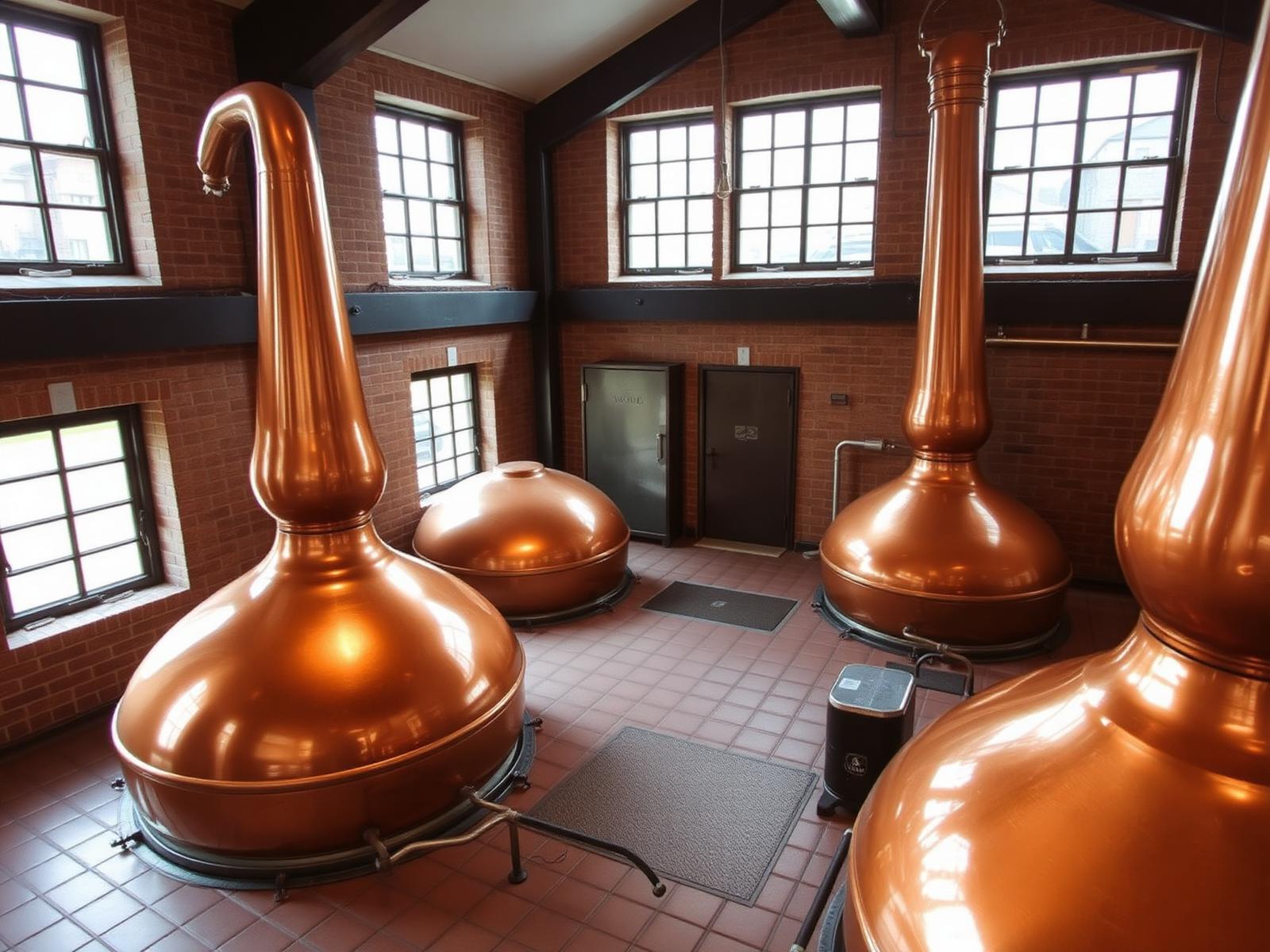
The copper pot still is the oldest continuously used piece of equipment in whisky production, and its basic form has changed remarkably little in five hundred years. A closed vessel is heated; the vapour rises through a neck, passes along an arm and is condensed. Everything else is refinement.
The apparatus reached Europe through Arabic alchemical texts translated in Spain and southern Italy from the twelfth century onwards. The word alembic derives from the Arabic al-anbiq, itself borrowed from Greek. Early European stills were used for perfumes, medicines and alchemical preparation long before they were applied to grain.
Why copper
Copper was chosen initially for practical reasons. It is malleable, can be worked into curved forms by hand, conducts heat efficiently and resists corrosion from the acidic wash. Every early coppersmith could work it; iron could not be shaped as readily and imparted unwanted characteristics.
The chemical role of copper was recognised only much later. Copper reacts with sulphur compounds produced during fermentation, removing them from the vapour stream. Distilleries that experimented with stainless steel found the resulting spirit markedly different, and copper was retained. The empirical practice preceded the explanation by several centuries.
Distillers understood what copper did to their spirit long before chemistry could tell them why.
Shape as signature
Still design determines how much of the rising vapour condenses on the interior surfaces and falls back into the pot — a phenomenon known as reflux. A tall, narrow still with a steeply ascending lyne arm returns a great deal of heavier material; a short, wide still with a descending arm returns little.
This is why distilleries replicate their stills with such exactitude. When a still is replaced after decades of service, the coppersmith reproduces every dimension, and in documented cases the dents accumulated over its working life. Whether a dent has any measurable effect is disputed; the reluctance to test the question is entirely rational.
The cut
The single most consequential decision in the still house is the cut. The spirit run emerges in three phases — foreshots, the heart of the run, and feints — and only the middle portion is collected for maturation. The foreshots carry volatile compounds; the feints carry heavier ones. The point at which the stillman diverts the flow into and out of the spirit receiver determines the composition of what will eventually be filled into cask.
Historically this judgement was made by observation: the appearance of the spirit when mixed with water, its behaviour in the spirit safe, the reading of a hydrometer. The spirit safe itself, a locked brass and glass box introduced in the nineteenth century, exists because excise officers required the distiller to make these judgements without being able to touch the spirit.
Automation has since made the cut points programmable at most sites. A number of distilleries retain manual operation, documented as a deliberate preservation of craft knowledge rather than a technical necessity.