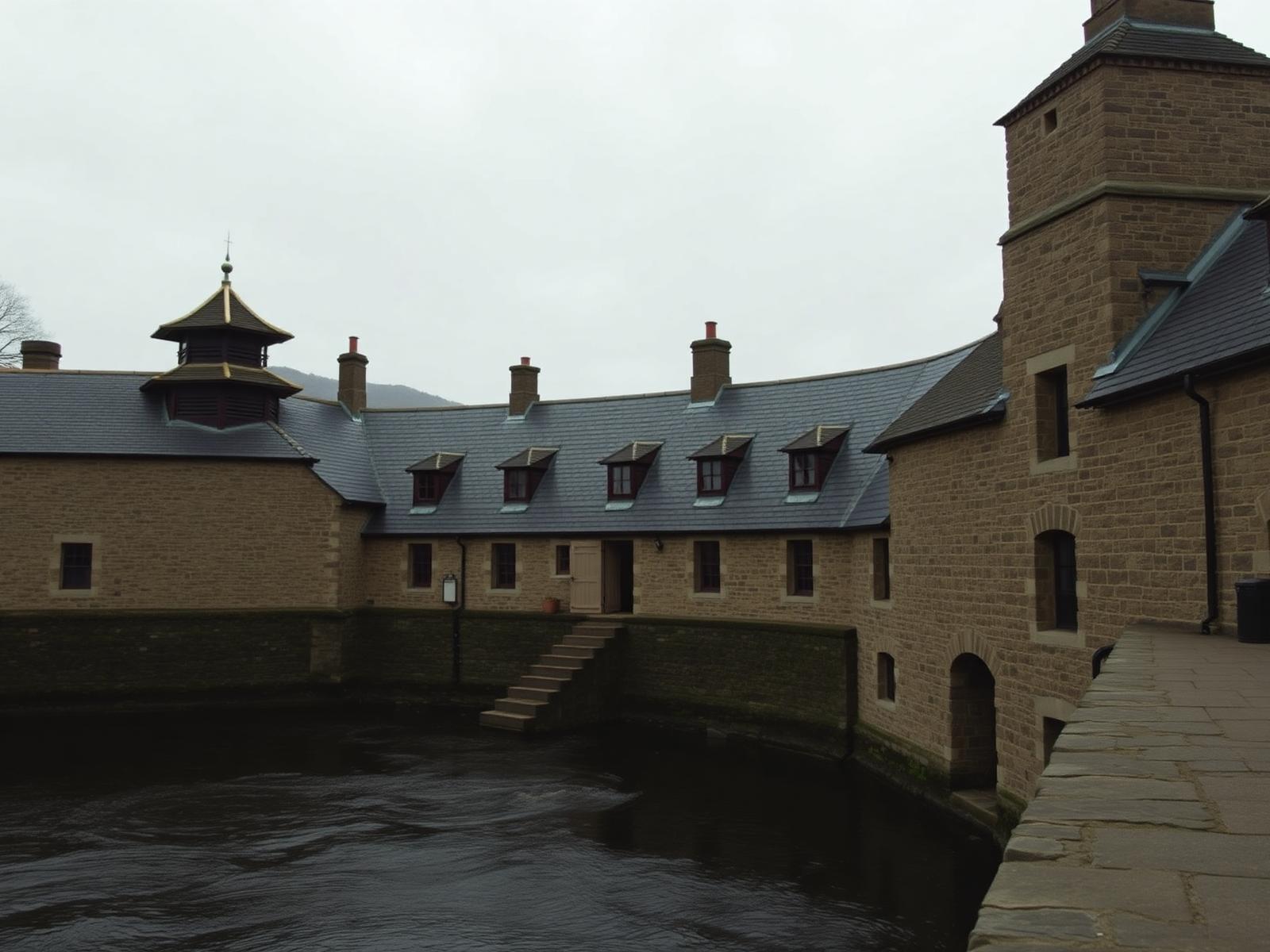
Almost every traditional method in whisky production is slower, more expensive and less consistent than its modern replacement. That a handful of distilleries retain them is therefore not an economic decision but a cultural one, and it has been documented as such by industrial historians and heritage bodies alike.
Floor maltings
Fewer than ten Scottish distilleries still malt any barley on their own floors, and most of those supplement it heavily with commercially malted grain. The work is physically demanding: grain must be turned by hand with a wooden shiel every few hours, day and night, for around a week, to prevent the germinating rootlets from matting together.
Commercial maltings do the same job with rotating drums, greater uniformity and a fraction of the labour. Where floor malting survives, it survives as a maintained skill — the maltman's judgement of temperature and moisture by touch is not written down anywhere, and it is passed on by working alongside someone who has it.
Worm tubs
The worm tub is the older form of condenser: a long coiled copper pipe submerged in a large vat of cold water, usually outdoors. It was universal until the shell-and-tube condenser replaced it during the twentieth century.
The technical difference is copper contact. A worm offers considerably less copper surface than a modern condenser, so fewer sulphur compounds are removed and the resulting spirit is heavier in character. Around a dozen Scottish distilleries retain worm tubs precisely for that reason — the older equipment produces something the newer equipment cannot.
In several cases the traditional method is retained not out of sentiment but because nothing modern reproduces its result.
Wooden washbacks
Fermentation vessels of Oregon pine or larch are harder to clean than stainless steel and must be re-coopered periodically. Distilleries that keep them argue that the resident lactic bacteria in the timber contribute to the character of the wash during long fermentations, and the point is supported by a reasonable body of technical work.
Heritage as method
What unites these practices is that each represents documented knowledge embodied in equipment and in people rather than in written procedure. Once a floor malting closes and its maltmen retire, the skill is not straightforwardly recoverable from records.
Several distilleries and industrial heritage organisations now treat these operations explicitly as conservation, maintaining them alongside archives, photographic records and oral history programmes. The argument advanced is not that the old ways are better in every case, but that a craft which loses its earlier methods loses the ability to understand its own history.